

Being A Good Human in the Attention Economy

A note to the reader
This isn’t a self-help guide, a productivity hack, or a set of steps to follow.
The Good Human Practice exists as a quiet space for reflection — a pause to consider what it means to live with purpose, not just profit, in a world that often feels noisy and fractured.
Each edition offers a single idea and an invitation to notice something differently. Not to fix you, but to help you see yourself — and others — more clearly.
There are no answers here. Only questions worth sitting with.
We live in an environment that places unprecedented demands on human attention. Consider what we’re up against:
Our senses take in about 11 million bits of data every single second; yet our conscious minds can only process about 120 bits per second
Humans produce the equivalent of 17 million terabytes of data in just one hour. We created more information in 2024 than was produced in all human history up to the year 2003 — a surge fuelled by the internet, AI, and the exponential rise of digital data
In 2004, people averaged 2.5 minutes on a single screen before switching; by 2012, this dropped to 75 seconds, and today it’s just 47 seconds.
We are living in an era where focusing for even a single minute has become a challenge
At the same time, many of the systems that mediate our lives — social media, news platforms, recommendation engines — are explicitly designed to maximize engagement by amplifying strong emotional responses like fear, anger, and outrage. Their business models depend on advertising revenues, which means their algorithms prioritize content that elicits the strongest reactions.
None of this is accidental. It is the landscape in which we are trying to live, decide, and be good humans.
In this kind of world, it’s reasonable to ask whether goodness even stands a chance.
When we are constantly pulled toward reaction, certainty, and outrage, how can anyone be expected to act with patience, restraint, or care? When the loudest voices are rewarded and the fastest reactions are amplified, doesn’t being a good human begin to feel like swimming upstream?
The uncomfortable truth is that much of the time, it does.
That isn’t an excuse.
It’s merely an observation.
And it points to something deeper about what it means to be a good human.
Being A Good Human Means Striving, Even Against the Odds
Being a good human has never been about choosing what’s easiest. It has always involved striving — acting with care even when the easier option is to simply give in, to go with the flow.
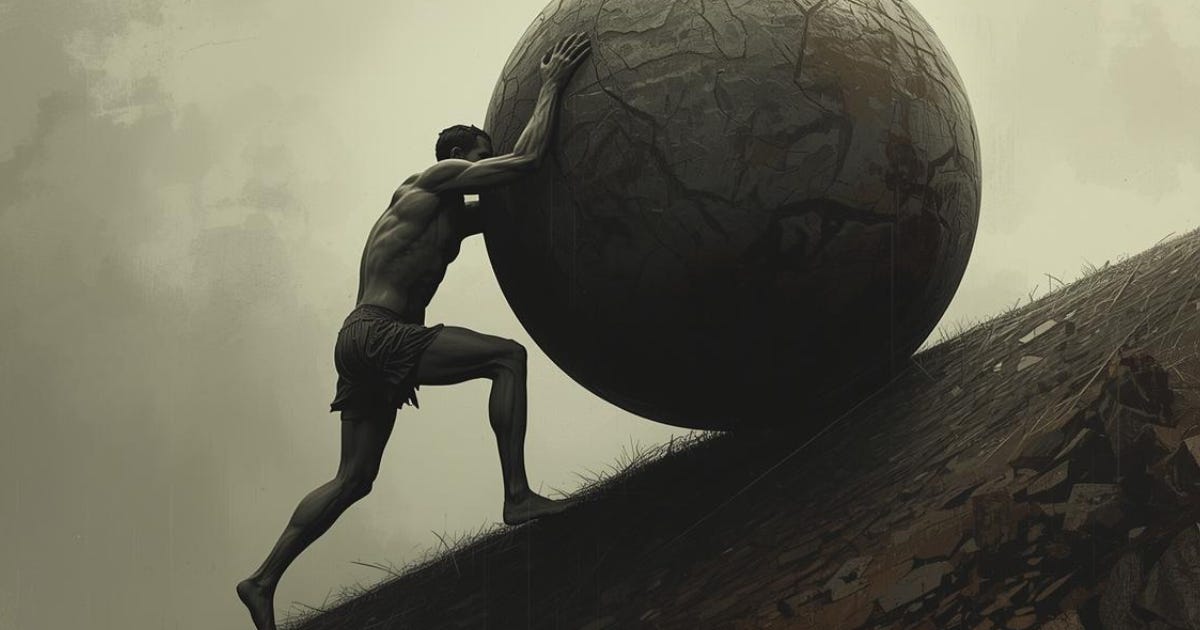
Albert Camus captured this in his retelling of the Greek myth of Sisyphus, appropriately titled The Myth of Sisyphus. Condemned to roll a boulder up a hill only to have it roll back down again, Sisyphus is often seen as a symbol of futility. That man can’t prevail against the gods or the powers that be. Camus saw something else: the dignity of persistence. The decision to continue, even when the task feels endless and hopeless. This isn’t a bug of humanity but a feature — our will to exist, our drive to persist, to persevere, to overcome.
Human progress has always followed this pattern. Millions died before antibiotics existed. Alexander Fleming discovered penicillin in 1928, but most scientists doubted it could ever be made clinically useful. A small team persisted anyway — and in so doing, changed the course of history.
Thomas Edison tried thousands of different filaments before finding tungsten, the one that would meet the necessary conditions for the light bulb. As he observed, “genius is 1% inspiration, and 99% perspiration.”
Persistence doesn’t guarantee success. But without it, success is impossible.
So what does this mean for those who want to live well — and be good — in an age that seems to reward the opposite?
It means accepting that this, too, is a kind of Sisyphean task.
Not one we can necessarily complete.
But one we can choose NOT to abandon.
To Thine Own Self Be True
Ancient traditions understood this. Stoic philosophers, Taoists, Hindu sages, and others lived through periods of upheaval and uncertainty of their own. They arrived at a sober conclusion: we cannot control the world, but we can take responsibility for ourselves, take control of our actions.
Epictetus, the Roman slave turned Stoic philosopher, put it bluntly: “Blow your own nose.” Do your part. Don’t wait for someone else to do it for you.
Others said it differently:
“Everyone thinks of changing the world, but no one thinks of changing himself.” (Tolstoy)
“It has often been said that a reformation should begin with each man reforming himself.” (Kierkegaard)
“Be the change you want to see in the world.” (Gandhi)
These ideas are easy to quote but hard to put into practice — especially now.
The attention economy doesn’t just distract us. It shapes us. It nudges us toward reactivity, certainty, and moral outrage — all of which feel satisfying in the moment but proves corrosive over time.
But goodness has never been about winning the moment.
It has always been about choosing how we show up — repeatedly — even when no one is watching.
This isn’t a call to disengage from the world or to retreat from complexity. And it isn’t a prescription for what you should believe.
It’s an invitation to notice where your attention goes, and what it brings out in you.
For the next few days, simply pay attention to your attention.
Notice what draws you in.
Notice what agitates you.
Notice when you feel pulled to react rather than reflect.
You don’t need to change anything yet.
Just notice.
In a world designed to scatter our attention, that alone is a meaningful act.
A closing note
The Good Human Practice is a biweekly reflection on living with purpose, not just profit, in an increasingly noisy and fractured world.
This isn’t self-help. It’s slow, meaningful practice.
If this essay stayed with you, sit with it. Notice what it surfaced. Return to it when you need to. If it feels worth passing along, you can do that too.
For leadership and decision-making work under uncertainty, I write a separate publication called The Uncertainty E.D.G.E.™.