

Just Turn Around
Our Marie Antoinette moment

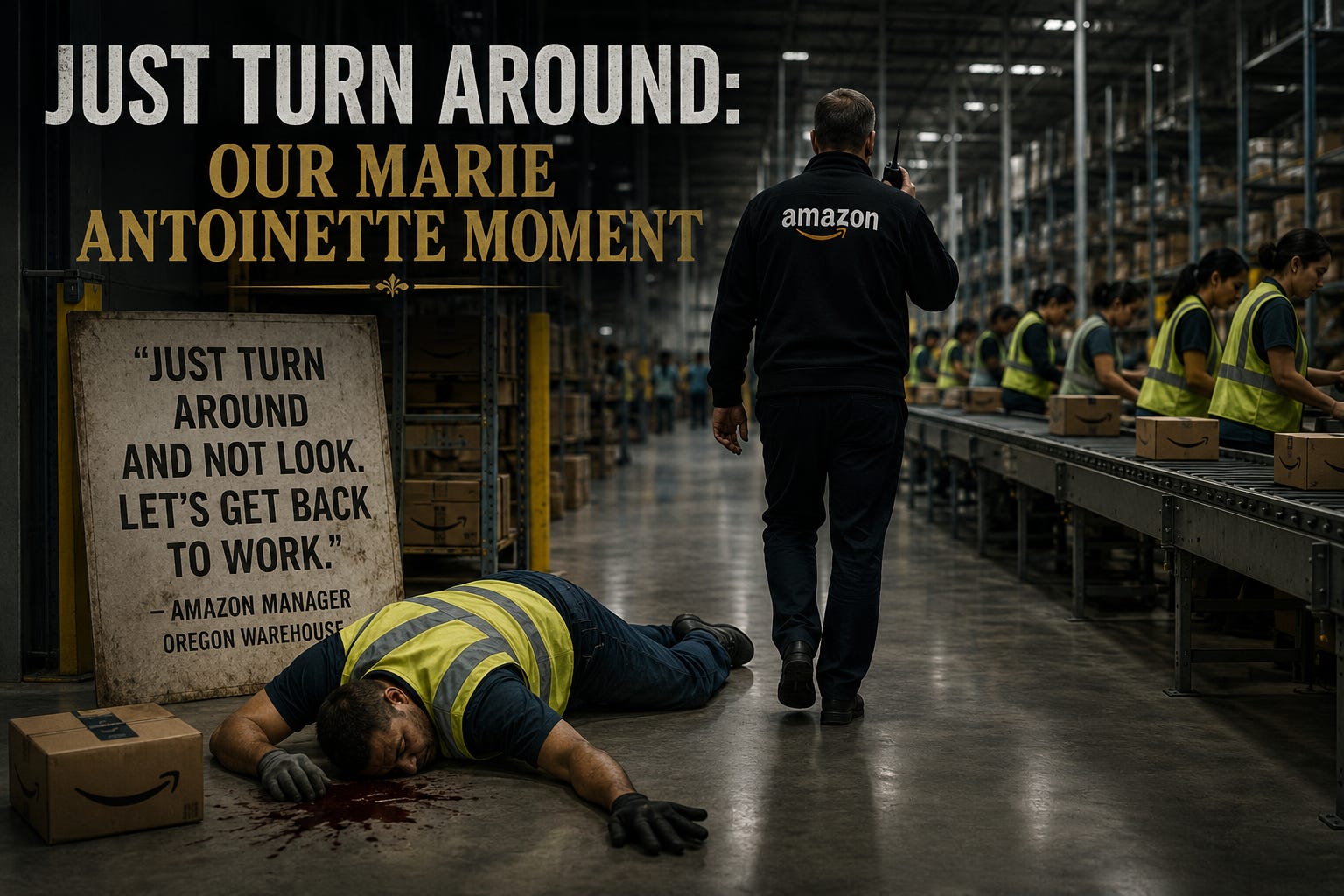
Image generated by ChatGPT
There are moments, phrases, that mark key turning points in our society. Not because they were spoken by persons with great power, not because they were articulated with particular elegance. One of these defining phrases was allegedly spoken recently by an Amazon warehouse manager in Oregon, after a worker collapsed and died on the floor beside his colleagues:
“Just turn around and not look. Let’s get back to work.”
That worker was a human being—a coworker, someone’s parent, someone’s child, a neighbor, a friend, someone who had a life ahead of them. Lying dead on the cold concrete floor. And the response was cold, clinical, institutional. Carry on. Do your jobs. Process those packages.
Within hours of the news breaking, a financial commentator apparently posted about the incident on social media beneath a single line: “This is why I’m bullish on $AMZN.”
These two moments, taken together, tell us something important about where we are. Not as a company, not as an industry, but as a society.
The Shape of Moral Blindness
We can look at this incident and call it cruelty, an outlier, and walk away. Soothing our consciences. But that would be the easy way out. We must resist that framing.
The incident revealed how quickly our society removes personhood from others, from the victims. I have no doubt that the manager had no personal animosity or hatred towards this worker. Nor that the investor felt any genuine malice to the worker. However, in their actions, what both revealed is that in their world, within their systems for interacting with the world around them, the dead worker didn’t register as a person. He was simply a disruption in production, a cog in the machinery of value creation.
This is where the system is leading us. Not outright malice, but indifferent erasure. The systematic removal of the “human” from humanity. Of social from society. Of common from community.
History teaches us about moments like this. I call them Marie Antoinette moments — though the famous queen is, in some ways, an unfair model for what the phrase represents.
Whether or not she actually uttered the words “let them eat cake” is beside the point. The phrase endures because it captured something structurally true about eighteenth-century French aristocracy. This was a class so insulated from the material conditions of ordinary life that it had lost the cognitive architecture to recognize suffering as suffering. This was not wickedness in the traditional sense. It was the moral blindness that descends on those who live entirely within a system that has never required them to see.
The aristocracy of pre-revolutionary France genuinely believed themselves to be good people. Many were generous patrons of the arts, devout citizens, loving parents. But the system within which they operated had taught them, through a thousand daily reinforcements, that the people who worked their estates, cleaned their halls, and died in their wars were of a categorically different kind. Not fully human in the sense that mattered.
What followed — the storming of the Bastille, the revolution, and eventually the guillotine — was not simply punishment for personal wickedness. It was the convulsion of a society that had allowed moral distance to become structural, and had ignored the warning signs for too long.
Today, I worry that we are accumulating warning signs.
The Pattern Is Not Isolated
To be clear, this Amazon incident is not an aberration but one of many recent data points. In 2013, 1,134 garment workers in Bangladesh were killed after being ordered back into a building with visible structural cracks. The workers at Rana Plaza were laboring over high-priced clothes for global brands who conveniently expressed condolences and their innocence over these dismal working conditions. Because, of course, the workers were employees of sub-contractors, not the brands themselves.
Even at Amazon, this is not the first incident. Documented records routinely show that Amazon has higher workplace injury rates than industry averages, that punishing productivity quotas often push workers to skip toilet breaks, that algorithmic quota systems automatically terminate underperforming employees without any human review. Workers have described a surveillance infrastructure so total that it treats them less as employees than as biological extensions of a logistics network.
Tesla’s Nevada Gigafactory has faced repeated scrutiny over worker injury data and what employees describe as a culture of pressure that makes reporting accidents feel professionally dangerous. Across the gig economy, from food delivery to ride-sharing, a generation of workers has been reclassified from employees to independent contractors, a legal sleight of hand that removes the protections of employment while retaining all of its control. These workers bear the risks of entrepreneurship while receiving none of its rewards.
In each of these cases, the same architecture is present: the physical and psychological distance between those who design the system and those who are consumed by it. The executive who sets the productivity target will never stand on the warehouse floor. The investor who tweets “bullish on $AMZN” will never see the body. The algorithm that manages the shift schedule has no capacity to register that a human being is unwell.
Psychological and physical distance is the mechanism by which moral blindness becomes structural.
What Philosophy Tells Us
This is not the first time human society has dealt with these kinds of questions and issues. Therefore, looking back at what the leading thinkers and philosophers had to say is instructive for our own timeline.
Immanuel Kant emphasized the need to treat people as ends in themselves, never merely as means. In this light, “just turn around and don’t look” fails precisely because it treated that worker as simply means to an end. That person’s existence had no validity or value of its own right.
Adam Smith, long before he became famous for his ‘Invisible Hand’ in the free market classic The Wealth of Nations, was a moral philosopher. His first major work, The Theory of Moral Sentiments, argued that the capacity for empathy, for imaginatively placing ourselves in others’ shoes, was the foundation of ethical and social life. Smith believed that markets required this moral foundation to function well. He did not imagine that markets and morality could be cleanly separated. That separation came later, and it was not his idea.
Hannah Arendt, writing in the aftermath of the most systematic horror of the twentieth century, introduced the concept of the “banality of evil” — the observation that the most destructive acts in history have often been performed not by monsters but by ordinary people operating within bureaucratic systems that had separated action from moral judgment. Adolf Eichmann, she observed at his trial in Jerusalem, was not a sadist. He was an administrator. He processed logistics.
The manager who said “just turn around” was, in all likelihood, also just an administrator. A person needing to meet their own performance metrics within a system that had trained them — through years of daily reinforcement — that the unit of moral significance was the package, not the person carrying it.
Too Simple a Formulation?
A reasonable critic might argue that this analysis is structurally unfair and overly simplistic. After all, corporations operate within rules that societies establish for them. If those rules are inadequate, the remedy, the critic would argue, is regulation, not moral denunciation. The manager in Oregon may well have been following protocols designed by people far above his or her pay grade. The investor was simply describing what the evidence suggested about operational efficiency. Neither created the conditions within which they were operating.
This is a serious argument and one worth considering. It is true that individual actors within systems bear limited responsibility for the logic of those systems or the impact of its application. It is equally true that the problem of corporate moral blindness is, at its root, a structural problem — one that requires structural solutions in the form of reforms to labor law, better regulatory oversight, and a culture of enforceable accountability.
But the argument fails at a crucial point. These systems are not self-generating. They are built and maintained by humans who make choices, and those choices reflect moral commitments whether those commitments are consciously held and explicitly made or not. The productivity target that made the manager’s response feel rational was set by a person. The reclassification of employees as contractors was chosen by a legal team on behalf of an executive. The decision to remain unmoved after a worker’s death was made by a human being with moral agency.
In other words, structural reform is necessary but not sufficient. It does not relieve individuals of the obligation to ask: in the system within which I am operating, am I treating the people around me as people?
I should add, at this juncture, that this is not meant to suggest that this is an easy mindset to follow in our hectic and time-crunched world. All of us, myself included, are busy trying to meet various deadlines, our minds are distracted, our to do lists are never-ending. But it is small steps. And it starts with awareness. For example, for most of my professional life, my head was down, my focus was task-oriented. When my daughter was about 4 years old, a walk in the streets of downtown Toronto, had a profound impact. She saw homeless people on the sidewalks and I could see that she was troubled. She asked about whether we could help that person. I had to explain to her that this was a wonderful sentiment but that we couldn’t help everyone. That seemed to satisfy her. But it left me troubled.
And it started a realization that this wasn’t good enough — for me. I made some changes — small admittedly. Since then, I try to make sure that I don’t just walk past a homeless person but acknowledge them and, if I can’t support them, at least say “sorry” and wish them a good day. I have also taken, when I can, to buying restaurant and coffee shop gift cards and hand them out when I come across someone who can use them. Does this solve the problems?
No, not at all. But, at least, I feel like I am seeing the “other”, recognizing the “person”. Admittedly, it also serves to make me feel good. I recognize my own bias here, but I would argue that feeling good is not, in and of itself, a bad thing, but we need to see if our awareness and actions stop here or if we are ready to go further.
What Comes Next
History suggests that societies have a tolerance threshold for moral distance — a point at which the gap between how institutions treat people and how people believe that they deserve to be treated becomes politically explosive.
Marie Antoinette did not lose her head because she was personally wicked. She lost it because she was the symbol of a system that had crossed that threshold, that Rubicon. The revolution that followed was not orderly, not proportionate, and not entirely reasonable. Revolutions rarely are. What they are is the belated, violent correction of accumulated moral debt.
We are not at the guillotine, but we might be walking towards it.
Trust in institutions sits at generational lows across the democratic world. Workers organizing — dormant for decades — is accelerating in precisely the sectors most associated with algorithmic dehumanization. The political energy driving movements across the ideological spectrum, however differently expressed, shares a common theme: the sense that the people who run things have stopped seeing ordinary people as fully real, as persons.
The question is not whether this tension resolves. It will, eventually. The question is whether we navigate the correction deliberately or convulsively.
The Work Ahead
In the first issue of The Good Human Practice, we explored the idea that goodness must be taught — that ethical behavior is not innate but cultivated through practice, instruction, and the modeling by those around us. The Amazon incident illustrates what happens when that cultivation fails.
The manager in Oregon was not born indifferent. He or she was conditioned into indifference by a system that rewarded productivity and penalized delay, day after day, year after year, until the death of a colleague presented itself primarily as a logistical inconvenience.
The investor who posted “bullish on $AMZN” was not born without empathy. He or she was formed by a financial culture that has elevated a single metric — shareholder return — to the status of a moral absolute, excluding all other values from the domain of legitimate consideration.
This is what moral education is ultimately about: not simply teaching children to give up their seats on the train, though that matters too. It is about cultivating the perceptual capacity to continue seeing the person across from you as a person — even when every institutional incentive conspires to help you stop.
A society that has lost that human capacity is not facing an economic problem, or a regulatory problem, or a political problem. It is facing a moral emergency.
And moral emergencies, as the history of the guillotine reminds us, tend to resolve themselves, often violently.
The real question is whether we choose to look — before we are forced to.
© The Good Human Practice | Published every other Thursday
If this resonated, I’d love to have you as a free subscriber — and forward this to a leader who is reflecting on clarity and character in how they make their decisions.
The Good Human Practice is a biweekly reflection on living with purpose, not just profit — written as I try to reconcile what’s happening in the world with what the great traditions teach us, and what I believe it means to live and lead well.
There are no tidy conclusions here. Only honest reflection and contemplation.
The inner work of leadership has a counterpart. If you’re also navigating high-stakes decisions and want frameworks for the outer clarity, I write separately about that in a free Substack newsletter: theuncertaintyedge.com