

Superman Isn't Coming
On hijacked ships, hollow skies, and the hands we've been given

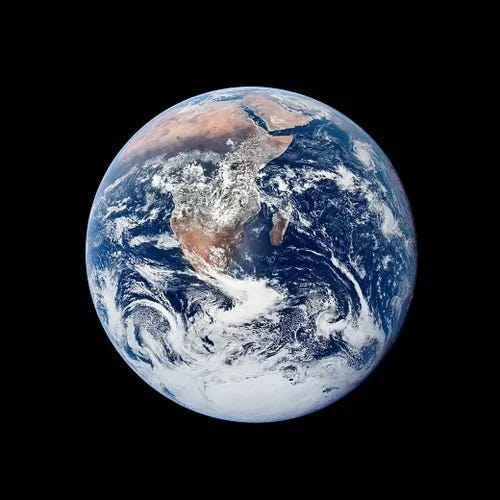
There is a photograph taken from space during Apollo 17 in December 1972. Most people have seen it but few have truly absorbed it. It shows Earth as it appears from space — a small, luminous marble suspended in absolute darkness. No borders. No armies. No flags. Just a single, fragile object drifting through an indifferent universe.
The astronaut Edgar Mitchell, who saw something similar on his return from the Moon in 1971, described an experience so overwhelming it permanently rearranged his understanding of reality. “You develop an instant global consciousness,” he said, “a people orientation, an intense dissatisfaction with the state of the world, and a compulsion to do something about it.” What struck Mitchell — what strikes nearly every astronaut who has seen Earth from space — was not the planet’s grandeur. It was its smallness. Its obvious, undeniable vulnerability. Ron Garan, who spent six months aboard the International Space Station, described looking down and feeling what he called “orbital perspective“ — a sudden, disorienting awareness that the thin blue line of atmosphere separating all of human life from the empty void was almost nothing. “It was such a contradiction,” he wrote, “between the beauty of it and the sad state of affairs on the surface.”
Years earlier, the philosopher and futurist Buckminster Fuller had arrived at the same intuition from his armchair. In 1963, he published the Operating Manual for Spaceship Earth, in which he offered a metaphor so precise and so devastating that it is perplexing that we have not taken it more seriously in the half-century since. We are, Fuller argued, crew members aboard a spaceship. The ship is extraordinarily well-designed, equipped with self-sustaining systems of breathtaking complexity — atmosphere, water cycles, soil chemistry, food chains — all interdependent, all finite, all operating without a spare parts depot anywhere within reach. There is no resupply mission coming. There is no backup vessel. And yet, Fuller observed, we are running the ship as though it were not fragile, as though its systems could absorb anything we choose to do to them, as though the decisions made in one compartment could never possibly affect the passengers in another cabin.
Fuller’s insight was not mere poetic licence. It was engineering logic. On a spacecraft, everything connects to everything else. The question he was asking — and that we have still not adequately answered — is this: how do you maintain a ship indefinitely when the crew refuses to understand that it is a ship?
I’ve been circling this question for longer than I can precisely date. It didn’t arrive as a revelation. It arrived the way most important things do — incrementally, through accumulation. A conversation about where food actually comes from. Reading about the water systems that make agriculture in one region possible and noticing, for the first time, that I’d never thought about water as something finite. Watching a news story about flooding in Pakistan and realizing, in the same moment, that I was watching it on a device whose manufacture I knew nothing about and whose supply chain I’d never once considered. None of these moments rearranged my life the way Edgar Mitchell’s view of Earth rearranged his. But together, over time, they made a certain kind of comfortable ignorance harder to sustain. The ship became real to me — not as metaphor, but as the actual operating condition of the actual world. And once you see it, the passenger posture starts to feel less like comfort and more like a choice you are actively remaking every day.
This question rings more urgent with every passing year, and the evidence accumulates in ways that should be definitive but somehow remains easy to ignore.
Everything Connects to Everything Else
Consider the Middle East. What began as a complex political and humanitarian crisis — most acutely in Gaza, but rippling across Yemen, Lebanon, Syria, Sudan, Iran and the wider region — has not stayed in the Middle East. Disruptions to agricultural supply chains, displacement of farming populations, blockages in critical shipping corridors, and the spiraling cost of fuel and fertilizer have contributed to food price instability that reaches into supermarkets in Toronto, Liverpool, and São Paulo. When a region that contributes significantly to global agricultural markets enters a sustained crisis, Spaceship Earth’s food supply system registers the stress. The passengers in the forward cabins feel it differently from those in the rear — but no section of the vessel is truly sealed off from the others. A conflict that many in the wealthy world experience as a news event viewed on a screen is, in its consequences, a material fact in the lives of people who cannot otherwise find the region on a map.
Or consider what the world’s industrial appetite — driven by wealthy and developing nations alike — has done to the ecosystem. The particulate matter and carbon dioxide released from coal-burning power plants and industrial zones do not respect national airspace. They enter the jet stream. They deposit themselves into weather systems thousands of miles from their origin.
The United States, still among the world’s largest per-capita emitters, continues to debate whether climate commitments are compatible with industrial competitiveness.
India, navigating the legitimate tension between lifting hundreds of millions out of poverty and meeting emissions targets imposed largely by nations that already completed their own carbon-intensive industrialization, is expanding coal capacity even as it invests aggressively in renewables.
Australia exports coal at record volumes while its own coastline is eroding.
Canada extracts bitumen from the oil sands while its western provinces burn.
The European Union imposes a carbon border tax while its member states quietly reactivate mothballed coal plants during energy crunches.
There is no clear villain in this story — which is precisely the point. The wildfires devastating British Columbia, the flooding across Pakistan, the desertification spreading across the Sahel — these are not just local catastrophes. They are the accumulated downstream consequences of decisions made in legislative chambers, boardrooms and shopping centres across the entire planet, each nation pointing at the others, each waiting for someone else to move first, all of them passengers on the same Spaceship Earth, watching the dials on the instrument panels edging into the danger zone, and still refusing to ease up on the throttle.
Or consider the smartphone in your pocket. Or the electric vehicle hailed as the future of clean transport. Both depend on cobalt. More than seventy percent of the world’s cobalt comes from the Democratic Republic of Congo. A significant portion of it is extracted through what human rights organizations have documented as artisanal mining operations that routinely involve child labour, coerced labour, and conditions that international law classifies as forced servitude. The global transition to renewable technology — the same transition we urgently need to address the climate crisis — is, in its current form, partly underwritten by human bondage in Central Africa. In other words, one of the proposed engineering solutions for the ship requires creating a catastrophe in another section of the hull. And the consumers funding it, on the whole, would rather not know.
I include myself in that. A few years ago, after reading about cobalt supply chains, I put my phone down and felt, briefly, the full weight of what I had just learned. Then I picked it up again. I have bought two phones since, one an older used version. I tell myself I held onto each one longer than I might have. I’m not sure that’s enough. I’m not sure what enough would even look like. But I notice I’ve stopped pretending the question isn’t there.
These are not distant abstractions. They are the operating conditions of a single interconnected system — Fuller’s spaceship — whose crew has largely convinced itself that they are not aboard a spaceship at all.
How did we arrive at this peculiar state of awareness? Why do people who are, in most respects, decent and intelligent and well-meaning continue to live as though these connections do not exist?
Iggy Pop’s song The Passenger, produced by David Bowie and released in 1977, offers one answer — not as argument but as portrait. The song has been interpreted in many ways, and my reading is simply this: it describes what it feels like to move through the world without agency, to watch it pass by with heightened but passive intensity, to find yourself carried along by a vehicle you did not choose and cannot steer. The passenger sees the city’s ripped backsides, the hollow sky, and finds in them a kind of beauty — which is, admittedly, not nothing. But the passenger is not driving. He has no destination. He has, somewhere along the way, relinquished the wheel.
This is not a portrait of malice. It is a portrait of abdication — and it captures something deeply real about the psychological posture many of us have adopted toward the systems that largely govern our lives. We know, in some abstract sense, that our choices have consequences. We know the ship is real. But the ship is so vast, and the mechanisms of cause and effect so slow and so mediated by distance and complexity, that it becomes possible — almost natural — to experience oneself as a passenger, watching a troubled world slide past the window, finding what comfort one can in the view. This abdication is understandable. The world’s problems are genuinely complex. The individual feels genuinely small against them. And there is a particular seduction in motion without responsibility, in being carried along rather than steering.
But seeking comfort is different from embracing complacency. And there is a point at which the passenger’s detachment ceases to be understandable and becomes its own kind of moral failure. Fuller was clear on this. The crew member who refuses to learn how the life-support system works, he argued, is not innocent by virtue of ignorance. On a spacecraft, ignorance is a luxury that the physics of the situation cannot afford.
From Passengers to Hostages
And yet the passenger metaphor, troubling as it is, may still be too gentle. Because a passenger, at least, is simply uninvolved. What the band Genesis described in their song Land of Confusion, released in 1986, is something more alarming.
The song talks of bewilderment — a narrator haunted by the spectacle of a world coming apart at the seams. To me this second verse cuts deepest, the one that has matured from period commentary into something that feels almost prophetic:
Oh Superman, where are you now
When everything’s gone wrong somehow?
The men of steel, the men of power
Are losing control by the hour.
The lyrics name a condition Fuller would have recognized immediately. The passenger is not merely passive. The passenger is waiting. Waiting for a figure of sufficient power and clarity to arrive and impose order on the chaos — a Superman, a strongman, a technological salvation, a leader who will absorb the complexity and return things to a condition of manageable simplicity. To a golden age of the past that existed only in myth and imagination. And while the waiting continues, the ship drifts. Decisions get made. Not by the crew. Not through any process that involves the crew’s active knowledge or consent. But by whoever has moved to usurp the space the waiting crew vacated.
This is where the metaphor shifts from passive to something darker. When the systems that were supposed to manage the ship — democratic institutions, international agreements, regulatory frameworks, functioning civil society, multilateral cooperation — are steadily captured by interests that have no stake in the welfare of the whole, then passengers do not merely drift. They are held in place. The ship has not been abandoned. It has been hijacked.
This hijacking doesn’t require villains in any satisfying cinematic sense. It requires only that the people making consequential decisions about the ship’s systems — energy, food, technology, finance — are structurally insulated from the downstream consequences of those decisions. That the costs land somewhere else. On someone else. In someone else’s lifetime. The genius of the arrangement is that it doesn’t need our active cooperation. It only needs our distraction, our exhaustion, and our willingness to accept the gap between what we know and how we live.
And here the analysis becomes uncomfortable, because that last sentence is also about me. I try, where I can, to close the gap. The food I buy, the suppliers I choose when I have the choice, the awareness I try to maintain of what things actually cost before the price is set. None of it is dramatic. None of it is sufficient. But I’ve come to think the alternative — deciding that marginal action is too small to bother with — is how the gap becomes permanent. The passenger tells himself the controls are too complex to learn. The crew member reads the manual, imperfect and incomplete, and tries anyway.
We, the passengers, did not board a hijacked vessel. We boarded a vessel that has been gradually, incrementally, systematically taken from us while we were looking out the window.
And yet, it is true that this analysis is too convenient, that it flatters the public and excuses the consumer. After all, people are not merely passive victims of capture. They are active participants in systems they find comfortable. The person who demands cheap electronics without asking what makes them cheap; the voter who rewards leaders who promise simple, painless solutions to deep, structural problems; the citizen who opts out of political life because political life is exhausting and complicated. These are not hostages in any straightforward sense; they are, at least partly, collaborators in their own constraint. The chorus of Land of Confusion acknowledges this directly, which is why it has not aged the way purely political songs tend to:
This is the world we live in
These are the hands we’re given
Use them and let’s start trying.
To make it a place worth living in.
This is not a demand addressed to leaders. This is a demand addressed to all of us.
Fuller made the same point, less melodically but no less forcefully. He was not interested in blame. He was interested in function. A spaceship does not care about the emotional reasons why its crew has neglected the life-support systems. It simply registers the neglect and responds accordingly. The question of whether the crew was deceived, or distracted, or simply tired, is philosophically interesting but operationally irrelevant. The systems are failing. The manual has not been read. And the time for comfortable complacency is over.
The View That Changes Everything
Edgar Mitchell returned from Apollo 14 in February 1971 and later spent much of his life reflecting on the meaning of that experience. The Overview Effect, a term coined by Frank White in 1987, has been described by a diverse group of astronauts including Russian Yuri Artyukhin, Saudi Sultan bin Salman Al Saud, and American Ron Garan. Together, their accounts describe Earth as a single, finite, interconnected system.
The tragedy is not that the view from space is unavailable to most people. The tragedy is that the view is available — through satellite imagery, through the testimony of those who have made the journey, through the patient work of climate and other scientists who have spent careers mapping the connections — and still the passengers sit with their faces turned toward their own windows, watching their own small portion of the ripped backside of the city slide past, finding what beauty they can in the hollow sky.
Fuller ended his book with a characteristic provocation. He noted that the ship had come equipped with everything necessary for an indefinitely long and comfortable voyage. The design was sound. The systems were elegant. The resources, properly managed, were sufficient. The only thing the ship had never been provided with was an operating manual — a document that made clear to every member of the crew what kind of vessel they were aboard, how its systems were connected, and what their individual responsibilities as crew members actually entailed.
He meant his book as a first draft of that manual.
Here is what the manual would need to make clear, if we were to rewrite it today: we are not passengers. We were never passengers. The passenger identity — comfortable, aesthetically engaged, morally uninvolved — is a role we adopted, partly through seduction and partly through exhaustion, and it has cost us more than we have as of yet been willing to acknowledge. The ship is real. The connections are real. The child mining cobalt in the Congo, the farmer watching his crops fail in a country most of us could not locate on a map, the firefighter in a Canadian forest fighting fires that won’t stop — these are not news stories. They are fellow crew members, in sections of the vessel we rarely visit, dealing with the consequences of decisions made collectively by all of us and for which none of us seem to be accountable.
Superman is not coming. We need to remember that these hands we have been given are the only hands available.
© The Good Human Practice | Published every other Thursday
If this resonated, I’d love to have you as a free subscriber — and forward this to a leader who is reflecting on clarity and character in how they make their decisions.
The Good Human Practice is a biweekly reflection on living with purpose, not just profit — written as I try to reconcile what’s happening in the world with what the great traditions teach us, and what I believe it means to live and lead well.
There are no tidy conclusions here. Only honest reflection and contemplation.
The inner work of leadership has a counterpart. If you’re also navigating high-stakes decisions and want frameworks for the outer clarity, I write separately about that in a free Substack newsletter: theuncertaintyedge.com