

The Freedom We Forgot
Why getting everything you wanted turns out to be the easy part

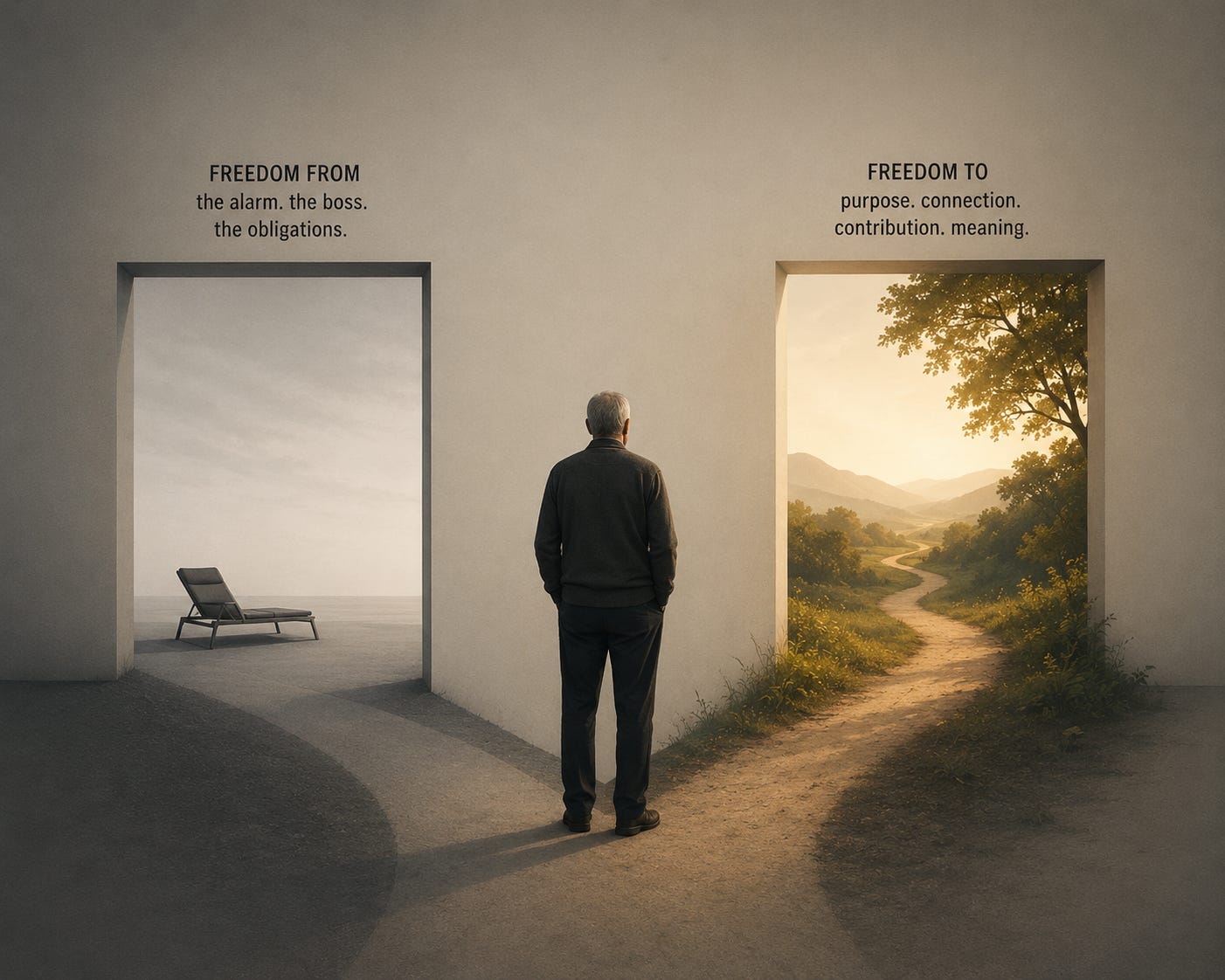
Picture the retirement party.
The card is signed, the cake is cut, and someone gives a speech about decades of service and all the adventures that lie ahead. The retiree smiles, maybe tears up a little, and says some version of the same thing everyone says: I can’t wait to finally have some time to myself.
Six months later, the calls start. Not the celebratory ones. The quieter ones. Golf gets boring after the third week. The house feels too large. The days blur together in a way that Monday morning at the office never quite did. The alarm clock is gone, the commute is gone, and the tyrannical boss, the pointless meetings, the bureaucratic nonsense—all of it finally, mercifully gone.
And in the space where all of that used to be: a shapeless, directionless, oddly oppressive nothing.
The retiree got exactly what they wanted. They spent thirty years dreaming of it, planning for it, counting down to it. They were meticulous about the financial conditions—the pension, the portfolio, the mortgage paid off. The one thing they never planned for was the existential condition: freedom to do what, exactly?
This is the question we almost never ask. And the failure to ask it turns out to be one of the most revealing blind spots in how we think about freedom, and about what makes a life worth living.
Two Kinds of Freedom
We are, as a culture, extraordinarily good at thinking about freedom as the removal of something unwanted. Freedom from the alarm clock. Freedom from the tyrannical boss. Freedom from the oppressive regime. Freedom from the social norm that constrained us, the institution that judged us, the expectation that weighed on us. We dream in negatives and measure liberation by what we’ve escaped.
What we are remarkably poor at is the harder question: freedom to do what?
This distinction has a formal name in philosophy. Isaiah Berlin, writing in 1958, called it negative liberty and positive liberty. Negative liberty is freedom from interference, the space cleared when obstacles are removed. Positive liberty is freedom to act, develop, become something, the capacity to actually use that space. Western liberal societies have built their entire political vocabulary around the first kind, while treating the second as either obvious or, at worst, faintly suspicious.
The suspicion has some basis. Telling people what they should be free to become has historically been used to justify enormous coercion—colonial civilizing missions, Soviet-style liberation toward a prescribed collective good, religious enforcement of someone else’s definition of the flourishing life. Berlin was right to notice the danger. When states or ideologies decide what your freedom should be for, things tend to go badly.
But here is where I think we made a serious error. We saw the dangers of positive liberty misused, and we overcorrected. We stopped asking the positive question altogether, told ourselves that if we just removed enough constraints, people would naturally figure out how to live well. And we settled on the comfortable assumption that freedom from interference was sufficient. That the good life would simply emerge.
It doesn’t. And it never has.
The Trouble with Infinite Freedom
Here’s a thought experiment I find clarifying.
Imagine you are immortal. You have infinite time, no obligations, no deadlines, no biological clock of any kind. You can do literally anything, for as long as you want, forever—the ultimate negative liberty, free from every constraint that limits ordinary human life. Now ask yourself honestly: does that sound like freedom? Or, on reflection, does it sound, like a peculiar kind of hell?
Without the constraint of limited time, no choice carries urgency. When you can always do it tomorrow, literally always and forever, why do it today? Without urgency, meaning starts to dissolve, and without meaning, motivation follows. The very thing that makes weekends matter is that there are only so many weekends. It is precisely the constraint of death, the hard border of a finite life, that makes our choices feel like choices at all.
You don’t need to invoke immortality to see this. Two weeks at an all-inclusive resort will do just fine.
Day one is glorious. No alarm, no emails, no obligations, and everything provided. You are, by any reasonable definition, free. By day four, a quiet restlessness sets in. By day ten, many people, though few will admit it, are secretly looking forward to going home. Not because something went wrong, but because nothing was required of them. And it turns out that humans, despite everything we tell ourselves, need to be required of.
Constraints are not the enemies of freedom. They are frequently the conditions that make freedom meaningful. The deadline makes the work matter. The commitment makes the relationship real. The finite nature of a life makes the choices worth making. Remove all of it, and you don’t arrive at maximum freedom. You arrive at the all-inclusive resort on day eleven: comfortable, purposeless, and quietly desperate for something to push against.
The Blind Spot We Export
This is worth sitting with when we consider how confidently the West has historically looked at other societies and rendered its verdict: those other people are not free.
The critique is frequently directed at the Middle East, at parts of Asia, at societies organized around strong religious codes, communal obligation, or social structures that constrain individual expression in ways that make Western liberals uncomfortable. And sometimes the critique is warranted. Genuine oppression exists and should be named clearly.
But notice what that framing consistently leaves out. It never asks what positive conditions those societies might provide—the dense webs of family and community, the intergenerational transmission of meaning, the clear frameworks of purpose and obligation, the sense that you belong to something larger than your own preferences. The critics simply assume that if we removed the constraints, people would flourish, because that is what our model promises.
But does our model deliver? The Western model stresses individualism, freedom from community constraints. The Eastern model focus on communitarianism, the importance of the cohesion and wellbeing of the community. The same Western societies championing negative liberty are experiencing epidemic loneliness, the collapse of civic institutions, and rates of anxiety, depression, and purposelessness that we have no real framework to explain, because by our own reckoning we have never been more free.
I want to be careful here, because this point is easy to misread. This is not an argument for authoritarianism, nor a defense of theocracy, nor a suggestion that constraining women’s freedoms or suppressing political dissent somehow produces flourishing. Those things are genuinely wrong and worth opposing.
It is, rather, an argument against the smugness that prevents us from asking an honest question: is it possible that societies we readily dismiss as unfree have preserved certain positive conditions for human life—community, shared obligation, intergenerational meaning—that our relentless expansion of negative liberty has quietly hollowed out? They may lack freedom from. We may lack freedom to. Neither in isolation is a complete human life, and neither has much basis for self-congratulation.
The Formation We Abandoned
This is where the argument connects to what we explored previously.
In the first edition of the Good Human Practice, I argued that we have stopped teaching goodness, that we have dismantled the institutions of moral formation and left people to figure out ethical life largely on their own. What I want to add now is that we did not dismantle those institutions randomly. We dismantled them, in large part, in the name of freedom.
Children should be free to develop their own values. Communities should not impose norms. Schools should not presume to teach character. Institutions should not enforce standards of conduct that some might find constraining. All of that is freedom from, and in practice it has functioned as moral abandonment wearing the costume of liberation.
Those Japanese schoolgirls I described in that first essay—the ones who stood immediately for the elderly couple on the train, who would not sit back down until the couple accepted their seats—were not oppressed by their formation. They were given something. They arrived at the moment of ethical choice already equipped for it, because someone had thought carefully about who they needed to become and had done the sustained work of getting them there.
That work requires positive conditions. It requires the presence of something—instruction, modeling, practice, community—not merely the absence of interference. You cannot raise a good human the way you grow a weed, by simply leaving it alone and trusting that nature will do the rest.
The Objection Worth Taking Seriously
Some will say: fine, positive formation is necessary, but who decides what people should be formed toward? That is precisely where the danger lives, and precisely why Berlin’s warning still matters.
It is a fair challenge, and the answer, I think, is that the danger is specific. It lives in state-enforced visions of the good life, in ideologies that decide what you should become and apply coercive power to get you there. That danger is real, and history has brutally demonstrated it.
But that does not describe a parent thinking carefully about what values to model for their child. It does not describe a community that maintains shared standards of conduct, or a school that takes character as seriously as calculus. None of that is coercion. It is, in fact, exactly the kind of positive formation that negative liberty cannot provide and was never designed to replace. The alternative to coercive positive formation is not the absence of formation altogether. It is formation located in the right places—families, voluntary communities, freely chosen traditions—rather than in the machinery of the state.
Back to the Party
The retirement party. The signed card, the smiling colleagues, the careful decades of financial planning.
Everything was prepared for except the one thing that turned out to matter most: who this person would be when the structure disappeared, what would give their Tuesdays shape and purpose, what they were actually for. That was never seriously examined, not because the retiree was foolish or unserious, but because the culture they were a part of had spent decades teaching them to dream of freedom from and had never once asked what they were becoming free to do.
That is not a personal failure. It is the logical outcome of a society that mastered negative liberty and forgot to finish the sentence.
Freedom is not the absence of constraints. It is the presence of something worth doing and the developed capacity to do it. The constraint of death makes our choices precious. The constraint of commitment makes love something more than convenience. The constraint of purpose makes Tuesday morning worth getting up for. Take all of that away, and you don’t find yourself liberated. You find yourself in retirement surrounded by everything you could possibly want, and quietly unsure what any of it is for.
That is not a life. It is but the shadow of one. And if we are serious about helping people live well—about building what this Substack is advocating—then freedom from is only ever half the answer.
Get comfortable to face the other half of the question—What freedom to do you really want?
© The Good Human Practice | Published every other Thursday
If this resonated, I’d love to have you as a free subscriber — and forward this to a leader who is reflecting on clarity and character in how they make their decisions.
The Good Human Practice is a biweekly reflection on living with purpose, not just profit — written as I try to reconcile what’s happening in the world with what the great traditions teach us, and what I believe it means to live and lead well.
There are no tidy conclusions here. Only honest reflection and contemplation.
The inner work of leadership has a counterpart. If you’re also navigating high-stakes decisions and want frameworks for the outer clarity, I write separately about that in a free Substack newsletter: theuncertaintyedge.com