

The Price of Convenience
How republics die — not through conquest, but through the slow surrender of civic virtue

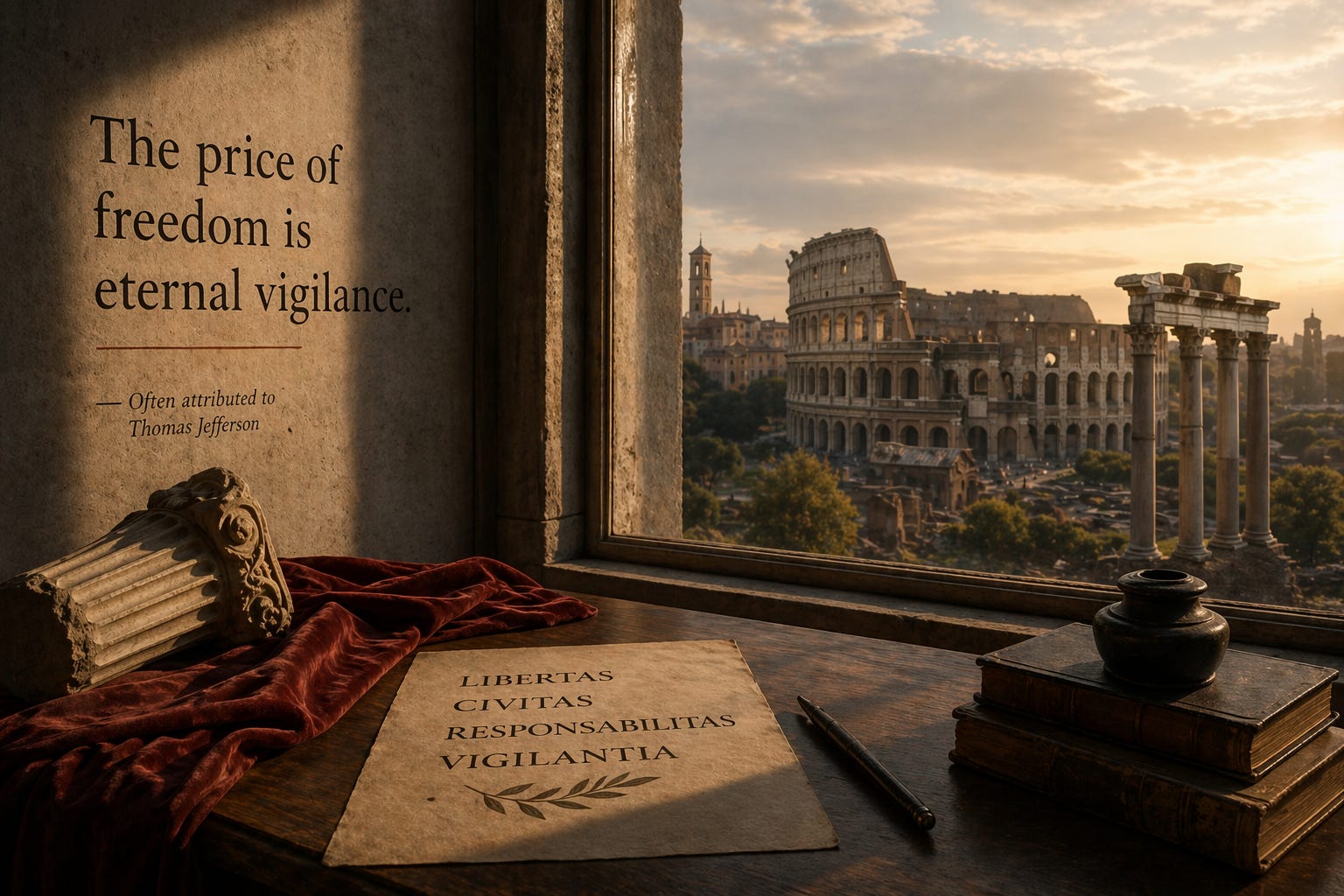
In the span of roughly eighty years — the length of a long human lifetime — the Roman Republic transformed itself into an imperial dictatorship.
If you had told a Roman senator at the beginning of the first century BCE that his grandchildren would live under a single ruler, the idea would have seemed unthinkable. The Republic had been founded explicitly in rejection of kings. For nearly five centuries — more than twice the length of the American experiment so far — Rome governed itself through representative institutions, legal norms, and a shared commitment to civic participation.
The Republic was flawed, unequal, and often brutal. But it was recognizably a system of self-government.
And then it wasn’t.
Rome did not fall because an external enemy overwhelmed it. Nor did it collapse in a single dramatic moment. Instead, it eroded from within — through a long sequence of accommodations, exceptions, and rationalizations. Each step seemed reasonable on its own. In accumulation, they proved catastrophic.
This history raises an uncomfortable civics question. What obligations do citizens of a republic have to preserve self-government — and what happens when those obligations are gradually surrendered?
Eternal Vigilance
The phrase “the price of freedom is eternal vigilance” is often attributed to Thomas Jefferson, though its precise origin is debated. Regardless of authorship, the idea captures something the Romans learned too late: freedom is not self-sustaining. It does not persist simply because it exists. It must be actively maintained.
The Roman Republic did not unravel overnight. It weakened through patterns that, in retrospect, feel eerily familiar.
Political violence, once unthinkable, became normalized. The murder of Tiberius Gracchus in 133 BCE marked a turning point. What had been shocking became precedent.
Unwritten norms eroded. Formal laws remained on the books, but the informal restraints that gave them meaning were abandoned. Power was exercised more aggressively, justified by necessity.
Factional loyalty overtook civic identity. Romans increasingly defined themselves by allegiance to political camps rather than by commitment to the Republic itself.
And constitutional principles were repeatedly suspended during moments of “emergency”. Each crisis justified extraordinary measures. Power, once centralized, was rarely fully relinquished.
None of this required villainy. It required only decent people failing to recognize the cumulative consequences of their accommodations.
Rome’s citizens did not wake up one morning and choose tyranny.
They chose convenience.
Stability.
Familiar leaders.
Short-term relief from conflict.
Security against perpetual enemies.
Over time, their vigilance weakened.
Early Warning Signs
One of the earliest warning signs appeared in how Romans treated dissent.
The principle often paraphrased as “I disapprove of what you say, but I will defend your right to say it” — while not directly from Voltaire — captures a hard-won civics insight of liberal societies. It separates emotional reaction from moral commitment. It asks citizens to protect the system that allows disagreement, even when disagreement feels threatening.
The Romans understood this in theory. Their public life prized debate, rhetoric, and persuasion. But as polarization intensified, political opponents were no longer seen as fellow citizens with differing views. They became enemies — obstacles to be silenced rather than interlocutors to be engaged.
The shift from I disagree with you to you must not be allowed to speak marks a dangerous inflection point in any republic. It signals a collapse in civic imagination — an inability to see opponents as part of a shared political project, of a shared humanity.
The Decline of Civic Virtue
Underlying these developments was a deeper erosion: the decline of civic virtue.
What sustained the Roman Republic for centuries was not merely its constitutional design, but the civic society habits of its citizens. Roman culture emphasized qualities such as pietas (duty to the common good), gravitas (seriousness about public responsibility), dignitas (honor in public conduct), and virtus (moral courage in the face of difficulty).
As historian Mary Beard has noted, Roman citizenship was not just a legal status. It was a daily practice.
Citizens did not merely consume governance. They participated in it. They understood that being a good person was inseparable from being a good citizen.
What is worth dwelling on is how that understanding came to be. These virtues were not spontaneous. They were cultivated deliberately — through education, through public ceremony, through the visible modeling of civic behavior by those in positions of authority. Roman fathers took their sons to the Senate. Orators were studied not only for their arguments but for the character they embodied. The Republic understood, at its best, that self-government was a practice before it was a principle — something exercised in daily life, not merely invoked in crisis.
When that cultivation stopped, the principles remained on paper while the practice quietly died. A republic whose citizens no longer exercised civic virtue was, in a meaningful sense, already hollow — waiting only for the right pressure to collapse inward.
Long before Julius Caesar crossed the Rubicon, many Romans had already crossed a quieter line. They had retreated from civic responsibility. They had ceded judgment to strong men. They had accepted erosion of rights as the price of comfort.
By the time formal institutions collapsed, the ethical foundations had already weakened.
How Republics Fail
This history is not valuable simply because it offers direct analogies or simple lessons. It is valuable because it reveals a pattern: republics fail not only when laws are broken, but when citizens cease to care about the norms that give those laws meaning.
Being good, in these contexts, is not limited to private virtue.
It includes attentiveness to shared systems. A willingness to tolerate disagreement. A refusal to sacrifice process for short-term outcomes. An understanding that self-government depends on citizens who remain engaged even when engagement is uncomfortable.
This is not about politics in the narrow sense. It is about ethical orientation.
Do we see ourselves primarily as consumers of outcomes, or as custodians of institutions?
Do we prioritize winning, or sustaining the conditions that make winning meaningful?
Do we withdraw when civic life becomes frustrating, or do we recognize frustration as part of the cost of freedom?
A Critic’s View
A reasonable critic might object at this point. They might argue that invoking Rome is too convenient — that the analogy flatters our anxieties without truly addressing them. Every generation, after all, believes itself to be living at the decisive moment of historical decline. The rhetoric of civic emergency has been weaponized so frequently, by so many factions, that it has become difficult to distinguish genuine structural concern from theatrical alarm. One could argue that institutions are more resilient than we fear, that democratic societies have absorbed worse shocks than the present, and that the very persistence of this hand-wringing across centuries suggests it reveals more about human psychology than about political reality.
To be fair, there is something to this argument. Vigilance can shade into catastrophism. The language of decline, wielded carelessly, can itself corrode democratic confidence — persuading citizens that the system is beyond saving before it has actually fallen. Fear, as much as complacency, has historically served those who would concentrate power.
But this objection, while worth taking seriously, ultimately reinforces the original concern rather than dismantling it. The fact that alarm has been misused does not mean alarm is never warranted. And the Roman case is instructive precisely because its citizens had every reason to believe their institutions were resilient. Five centuries of self-government is a powerful argument for durability. It turned out to be insufficient. The lesson is not that decline is inevitable — it is that a history of durability was never the protection Romans imagined it to be.
Decline disguised as Pragmatism
The Roman experience reminds us that democratic decline rarely announces itself. It arrives incrementally, disguised as pragmatism.
It also reminds us that historical memory carries ethical weight. Unlike the Romans, we are not without precedent. We can study Athens, Rome, Florence, Weimar Germany, and countless other cases where self-government gave way to concentration of power. This knowledge imposes a responsibility — not to predict outcomes, but to remain attentive to patterns.
George Santayana’s warning is often quoted but rarely absorbed: “Those who cannot remember the past are condemned to repeat it.” Remembering, in this sense, is not about memorization. It is about moral attention.
The ethical duty of democratic vigilance is quiet and unglamorous. It does not confer status. It rarely feels urgent until it is too late.
But it is foundational.
Self-government is not preserved by constitutions alone. It is preserved by citizens willing to notice erosion, resist normalization, and remain engaged even when doing so is inconvenient.
Rome did not fall in a day. It eroded across decades of quiet choices — choices made by people who believed, at each moment, that they were being sensible rather than complicit.
Rome’s fall was not inevitable.
It was cumulative.
That distinction matters more now than it ever did then. Because we have the benefit of knowing how the story ended. The Romans did not.
© The Good Human Practice | Published every other Thursday
If this resonated, I’d love to have you as a free subscriber — and forward this to a leader who is reflecting on clarity and character in how they make their decisions.
The Good Human Practice is a biweekly reflection on living with purpose, not just profit — written as I try to reconcile what’s happening in the world with what the great traditions teach us, and what I believe it means to live and lead well.
There are no tidy conclusions here. Only honest reflection and contemplation.
The inner work of leadership has a counterpart. If you’re also navigating high-stakes decisions and want frameworks for the outer clarity, I write separately about that in a free Substack newsletter: theuncertaintyedge.com