

The Scorpion’s Paradox
We don’t fail because we don’t know better—we fail because we stop noticing we have a choice.

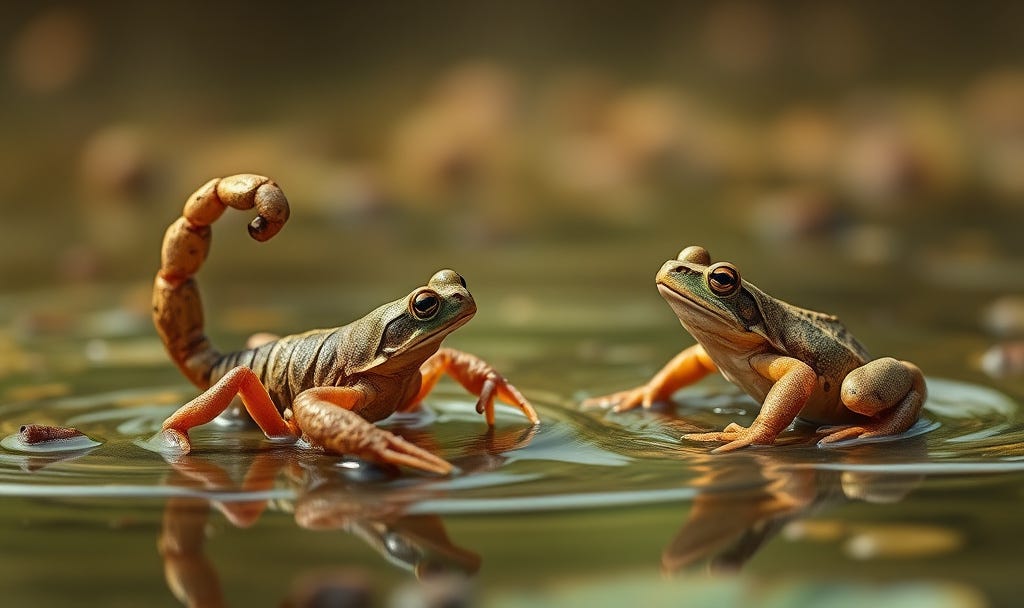
There is an old fable about a scorpion and a frog.
The scorpion asks the frog to carry it across a river on its back. The frog hesitates, knowing the scorpion’s sting would be fatal. The scorpion reassures the frog that stinging it would make no sense; after all, both would drown. Appealing to reason and self-interest, the scorpion convinces the frog to agree.
Halfway across the river, the scorpion stings the frog anyway.
As they sink beneath the surface, the frog asks why.
“It’s my nature,” the scorpion replies.
It’s a bleak story, often told as a warning about misplaced trust. But there’s something deeper, and more unsettling, embedded in the detail. The scorpion doesn’t deny the consequences, even to itself. It understands them perfectly. It simply cannot act otherwise.
When you widen the lens far enough, the story begins to feel uncomfortably familiar.
We live in a moment defined by consequences we can see clearly and discuss endlessly. Climate instability, democratic erosion, widening inequality, wanton injustice, institutional fragility; none of these are surprises. We track them in real time, publish reports, debate causes, and model future outcomes with remarkable precision.
And yet, collectively, we continue to behave in ways that accelerate the very outcomes we claim to fear.
The crisis isn’t only environmental or political.
It’s a crisis of consciousness.
Today’s world place unprecedented demands on human attention. Our senses absorb vast amounts of information every second, while our capacity for deliberate thought remains limited and fragile. The volume of information we produce has exploded, even as our ability to sit with complexity has radically diminished. At the same time, many of the platforms mediating our lives are designed to reward speed, certainty, and emotional intensity rather than patience, humility, or care.
None of this is accidental. It is the landscape within which we are trying to live, and trying to be good humans.
Over time, what once felt extraordinary becomes routine. Record temperatures blur into background noise. Democratic norms erode incrementally, rarely in ways dramatic enough to provoke sustained resistance. Widening inequality becomes a statistic rather than a lived moral question.
Aldous Huxley once warned that people would not need to be oppressed if they could be distracted into passivity. His concern was not censorship, but saturation; a world so full of stimulation that nothing is attended to long enough to matter.
In such a world, moral attention becomes scarce.
This normalization happens quietly. It rarely arrives through dramatic collapse. Instead, it unfolds through a thousand small acts of disengagement; moments when looking away feels easier than staying present, when convenience outweighs conscience, when resignation replaces responsibility.
Democracy offers a revealing parallel.
Nearly two centuries ago, Alexis de Tocqueville warned of what he called “soft despotism” — a condition in which democratic forms remain intact while citizens gradually withdraw from meaningful participation. This reminds me of the old tale about the boiling frog, even if it is not accurate. The idea is that a frog placed in a pot of boiling water would jump out immediately; but in a pot of cold water that slowly is brought to boil, the frog doesn’t even notice until it is too late.
De Tocqueville is warning us about the latter scenario. Power becomes centralized not through force, but through comfort. People are not coerced; they are absorbed. Political life shrinks not because it is forbidden, but because it feels burdensome. The civic muscle weakens not from attack, but from neglect.
And like any muscle, once it atrophies, it becomes harder to engage again.
At this point, it is tempting to accept the scorpion’s conclusion; to believe that perhaps humans, too, are bound by their nature. That self-interest will always win. That large-scale change is impossible. That awareness without action is simply how things are.
But the fable breaks down precisely there.
Unlike the scorpion, humans are capable of self-reflection.
We can notice patterns in our behavior, question them, and choose differently; even when — especially when — doing so is uncomfortable, costly, or socially inconvenient. This capacity is not guaranteed. It must be exercised. And in environments designed to keep us reactive, it weakens easily.
Still, history suggests it matters.
Every meaningful social transformation began with individuals who refused to accept what had come to feel inevitable. The abolition of slavery, the expansion of civil rights, the movement for women’s suffrage; none emerged because conditions were favorable. They emerged because people interrupted habit with conscience, and convenience with care.
These shifts did not begin with perfect clarity or universal agreement. They began with people who noticed something was wrong and chose not to look away.
Buckminster Fuller once described humanity as passengers aboard “Spaceship Earth”. The humans on board have different cabins — some high luxury, some standard, some basic or even below basic. But they all share one life-support system. And if that system fails, it fails for everyone.
The metaphor is ecological, but its implications are ethical.
No individual can flourish indefinitely in a society where trust erodes, empathy collapses, and shared responsibility disappears. Like the branches of a tree, individuals depend on the health of the whole. When the trunk withers, no branch escapes the consequences.
This is not a call to heroism.
And it is not a demand for purity.
It is a quieter invitation to reflect on where we may have confused habit with inevitability.
Where have we accepted patterns simply because they feel entrenched?
Where have we surrendered choice because reflection felt inconvenient?
Where have we mistaken “the way things are” for “the way they must be”?
The scorpion’s tragedy is not that it stings.
It is that it never wonders whether it could do otherwise.
Humans can.
That capacity — to pause, to question, to choose — may be the most fragile and most important thing we possess. It is easily eroded by noise, speed, and certainty. And yet, without it, goodness becomes accidental rather than intentional.
The work of being good has never been easy. It has always required attention. What is different now is how systematically that attention is fragmented.
In such conditions, even small moments of reflection matter.
Not because they solve anything.
But because they remind us that we are not bound entirely by instinct or habit.
We can still ask better questions.
We can still resist default options.
We can still choose how we show up — even when no one is watching.
That may not save the world.
But it may save something essential in us.
And sometimes, that is exactly where change begins.
© The Good Human Practice | Published every other Thursday
If this resonated, I’d love to have you as a free subscriber — and forward this to a leader who is reflecting on clarity and character in how they make their decisions.
The Good Human Practice is a biweekly reflection on living with purpose, not just profit — written as I try to reconcile what’s happening in the world with what the great traditions teach us, and what I believe it means to live and lead well.
There are no tidy conclusions here. Only honest reflection and contemplation.
The inner work of leadership has a counterpart. If you’re also navigating high-stakes decisions and want frameworks for the outer clarity, I write separately about that in a free Substack newsletter: theuncertaintyedge.com