


Last week, the world was treated to one of the most blatant scandals witnessed in recent years. One that violated every norm and sense of right and wrong. A violation of norms that seemed to transcend race, religion, ethnicity, gender or flag. Everyone was, for once, in vocal agreement.
No, I am not talking about the latest ICE roundups in the US. Or the latest ceasefire violations in the Middle East.
I am talking about the red card debacle that shocked the world!
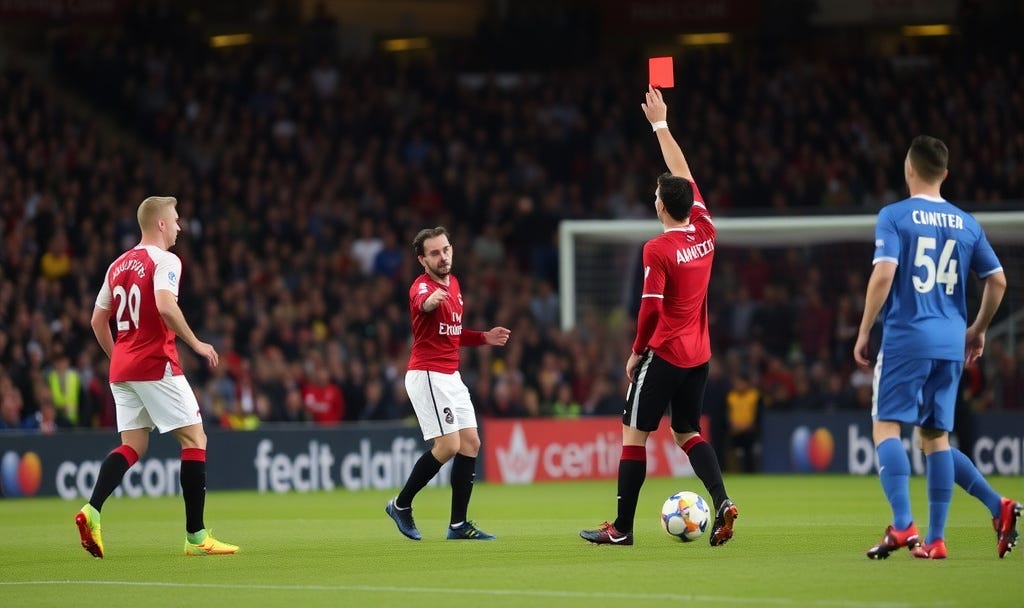
For those studiously avoiding football’s World Cup being played in North America, let me give you a brief refresher. Folarin Balogun, the US’s top scorer in the tournament, was given a red card for a foul on the opposing player from Bosnia-Herzegovina. The play was reviewed on the spot and the red card decision stood. It meant that Balogun would not be eligible to play the US’ next match against Belgium.
In any other world, that would have been that. Plenty of players get red cards, deserved or undeserved, and protests notwithstanding, they follow the rules and sit out the next game. For example, England defender Jarell Quansah was sent off during England’s 3-2 victory over Mexico on Monday following a high challenge. The English Football Association considered appealing the decision, though no intervention nor reversal occurred.
What made the Balogun red card so noteworthy is the statement made by President Trump in the days’ after the red card was awarded and hours before the next game against Belgium. Trump declared that he had asked his good friend, Gianni Infantino, the head of the tournament’s organizer FIFA, to review the red card. Of course, Infantino would not normally be reviewing a red card decision. Then again, Infantino wouldn’t normally be awarding a FIFA World Peace Prize to Trump, as he did earlier this year. Infantino denies intervening; Trump claims he did. All that matters is FIFA then suspended the one‑match ban — an extremely rare World Cup reversal that allowed Balogun to play despite protests from Belgium and criticism from UEFA.
In perhaps the ultimate manifestation of irony, the US would go on to lose 4-1 to Belgium.
But not before the rules of football, like the rules-based order and international law before it, were completely exposed to be at the whims of those who could make a call and have the rules rewritten to their liking.
As interesting a topic as that is, it is not the topic of this article. It is a deeper, perhaps more metaphysical question that this article seeks to explore. What, exactly, does it mean to belong? And, perhaps equally important, who gets to decide?
US Birthright Citizenship
What is missing in much of the public debate about Balogun is the back story and the side story.
Here is the back story:
Balogun was born in the United States to British Nigerian parents. His mother was turned away by the airline from her return flight to Britain because of her advanced pregnancy. So she was forced to give birth in the US before returning to Britain a month later. And thus Balogun became a US citizen and was therefore eligible to play for the US in this World Cup (he is also a British and Nigerian citizen). A right he embraced with the willing and vocal support of the US soccer establishment, the US President, and most of the US fans who were only too happy to cheer Balogun’s achievements on the field.
Here is the side story:
Balogun’s right to US citizenship is what is called “birthright” citizenship, a right to US citizenship by virtue of being born on US soil. In January 2025, the Trump administration signed an executive order attempting to end birthright citizenship for children of undocumented immigrants and temporary visitors. In other words, the executive order would have specifically targeted people like Balogun from getting US citizenship. The US Supreme Court, on June 30 2026, struck down this executive order as unconstitutional.
The President who intervened, and proudly took credit, to rescind a red card to his country’s top scorer was for the previous year and a half actively trying to rescind citizenship rights for people like Balogun.
That is a head scratcher, at first blush. But not so much on closer scrutiny.
We Stand Ready to Claim our Heroes
Kylian Mbappé, one of the top players in the football world, was celebrated for France’s 2018 World Cup win. All of France was proud to call him a Frenchman. But after France’s loss to Argentina in the 2022 World Cup final, Mbappé and other Black French players were subjected to racist online abuse, including slurs implying they were not truly French, and comments likening them to apes or telling them to go back to the jungle.
Mario Balotelli, born in Italy to Ghanaian parents, endured repeated racist abuse that often questioned his belonging as an Italian footballer. Even while playing for the national team, he faced monkey chants, insults, and broader hostility that reflected a narrow and exclusionary view of Italian identity.
Serdar Tasci, who was born in Germany to Turkish parents and played for the German national team, was also the target of xenophobic abuse that questioned his belonging. Reporting at the time quoted messages such as ‘The Germans will never accept you’ and ‘traitor to the fatherland,’ showing that criticism of his football skills could easily slide into attacks on his identity and loyalty.
Marcus Rashford, born in England to parents from the West Indies, was celebrated as one of England’s bright young stars during the 2018 World Cup run, but he later faced a wave of online abuse after missing a penalty in the Euro 2020 final shootout and again after England’s 2022 World Cup exit. The abuse included racist remarks, showing how quickly public admiration can turn into hostility.
This Hero-to-Zero mindset is notable for what it implies. When you behave as we want you to, we can accept you as part of our society; when you don’t, you are expendable. In effect, belongingness here is purely transactional. You belong based on our rules and that can change at any time.
This transactional belongingness is not limited to football or to Europe. As a Canadian, I was a first year university student when my dormmates and I celebrated Ben Johnson’s historic 100 m gold medal at the Seoul Olympics in 1988. For a brief moment, there was a warm glow and a sense of national pride that a Canadian had won the signature event in track and field. Then the story changed: Johnson tested positive for steroids, the gold medal was stripped, and the coverage quickly shifted from triumph to disgrace. Afterward, much of the reporting emphasized that he was Jamaican-born, an emphasis that was somehow absent before the cheating scandal, even though he had been representing Canada all along.
Do I Belong?
This brings me to my existential question. Do I belong? Am I Canadian enough?
For context, I moved to Canada from India when I was five. I did my undergrad and graduate degrees in Canada. I had a paper route when I was 9 and I have been paying taxes since I was 16. I cheer for the Montreal Canadiens in hockey, the Toronto Blue Jays in baseball, and the Toronto Raptors in basketball.
Am I Canadian enough?
My 23-year old daughter was born in England to me and my Austrian wife. We moved back to Canada before her second birthday and she has grown up here ever since. She went to school in Toronto. She just graduated from university in Waterloo. Along the way, she worked co-op jobs and paid her taxes. Is she Canadian? Is she Canadian enough?
The uncomfortable question I am leading to is: what does being Canadian mean today? To too many these days, being Canadian or British or American is a dog whistle. It is a dog whistle designed to imply that you have to be born of a certain color to parents of a certain ethnicity for your nationality to be never questioned.
Let me share one story from about fifteen years ago at work. I was running a wealth management business in Canada. One of the advisors on my team, let’s call him Jeremy, was also looking after the portfolios of my wife and I. Jeremy was a European national, and he and I were chatting over a coffee one day. The conversation happened to drift to discrimination and racism and whether it existed anymore in his home country or Canada. I said, let’s try a thought experiment:
You know my wife. She and I walk into a fancy restaurant in Toronto and are waiting at the front to be seated at our tables. At that moment, before either of us have opened our mouth, who does the room think is the immigrant and who is the Canadian? Jeremy was silent. That was the point. As soon as my wife opened her mouth and spoke in her Austrian accent, or I opened my mouth and spoke in my Canadian accent, the answer was clear. But until then, most people would have assumed the opposite.
The harsh reality, one I reluctantly accept, is that to some in Canada, I will never be Canadian enough. My daughter will never be Canadian enough. No matter that neither of us know a different home. For those people, I recognize that they can’t see past their own prejudices. I also realize, gratefully, that these people are very much a minority. Unfortunately, I also realize that this minority is becoming much more vocal, much more brazen, much more willing to be public about their views.
In a photo taken by Reuters photographer Cheney Orr that has since gone viral, a black woman rides the Washington DC metro surrounded by masked members of the Patriot Front, a white supremacist organization in the US. This was on July 4th, 2026. The day Americans celebrated 250 years of their independence. A long and proud history of fighting for civil rights, for the dignity of the individual.
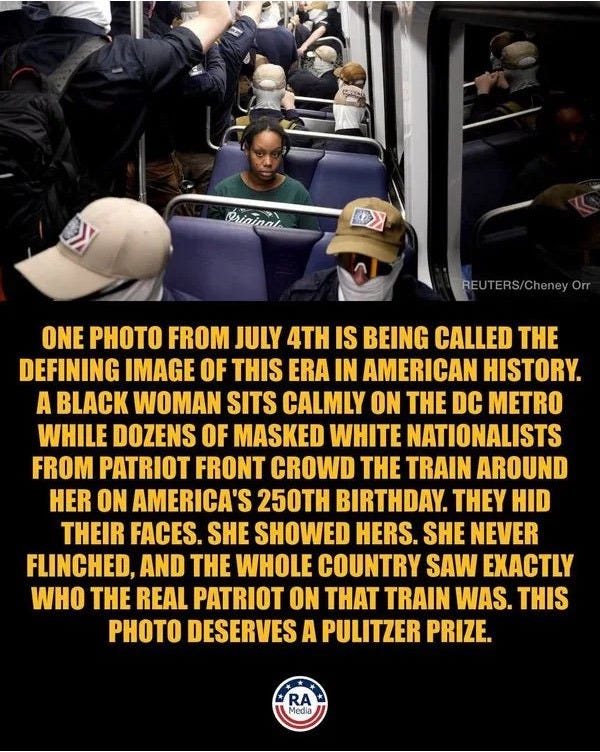
The irony is not subtle in the photo – apparently there are different shades of American citizenship. Again, irony being consigned to the dustbins of history, Trump’s intervention for Balogun, a black player, was on July 5th. So an administration that many critics have criticized for overt support of white supremacist policies violated global sports and football norms by advocating for a black player who they for more than a year sought to make ineligible for US citizenship.
Truth is indeed stranger than fiction.
This is not a commentary on American politics. It is an observation about all politics as it stands today. Belongingness has become weaponized by populists and tribalists as a way of determining worthiness. Who is worthy of being called a Canadian, a Brit, an American? Who is worthy of being supported by the state and entitled to the rights and benefits of being a citizen? Who is entitled to protection by the police, to access healthcare, or simply to the right to live peacefully, to exercise free speech?
This weaponization is not happening in the shadows. The dog whistles are being used more and more frequently in mainstream politics, in mainstream media, in daily conversations. This taboo left to dark corners in recent years is now becoming acceptable to be shared in broad daylight. Many politicians, always ready to jump on the next ballot-winning initiative rather than standing on principle, are willing to hum and hah, and hedge their way (e.g. “there are many fine people on both sides”) around the issue. Leadership and principle, it seems, are consigned to being oxymorons.
Where does this end? I don’t honestly know.
I know that the many friends I have in Canada, and around the world, transcend this pettiness, this transactional view of human lives. I would like to believe that they represent the majority, that this basic decency is a shared value of being Canadian, or any other nationality for that matter. That these values transcend race, religion, ethnicity, nationality or color of the skin. Certainly my friends, in Canada and around the Globe, are that way.
But then again, as the famous Russian dissident, Alexander Solzhenitsyn said: The battleline between good and evil runs through the heart of every man.
And in a quote attributed to Edmund Burke: All that is necessary for the triumph of evil is for good men to do nothing.
History has proven both quotes right. The question that remains is: do we have the collective will to prove that evil will not once again triumph?